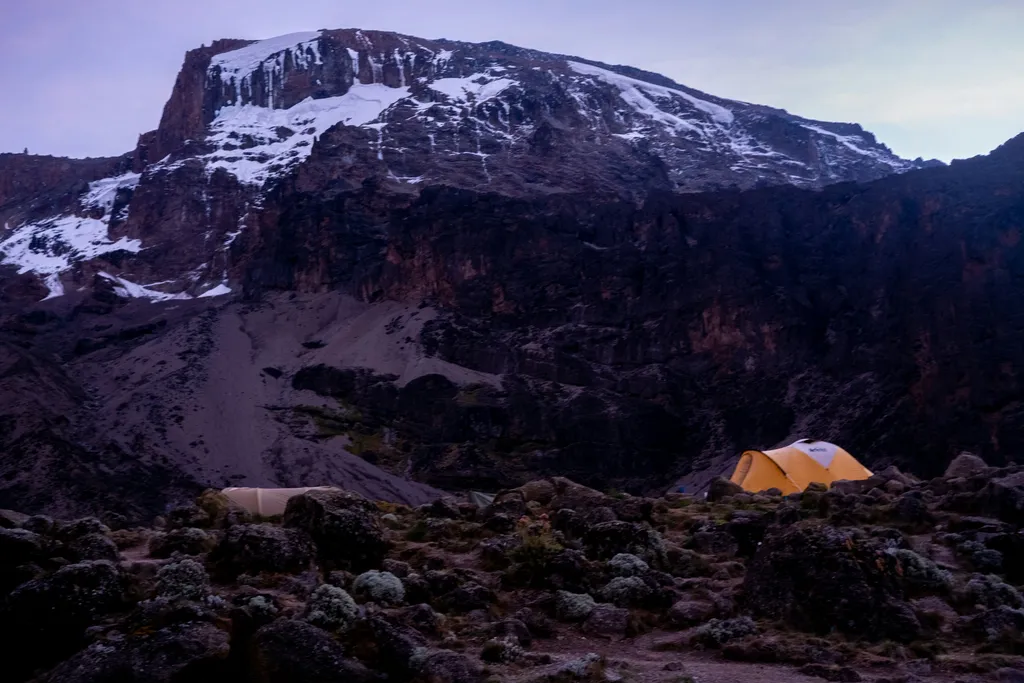
Every Kilimanjaro camp needs four groups of equipment: shelter (climber, mess, kitchen, crew, guide and toilet tents), camp furniture (tables, chairs, mattresses), kitchen supplies (stove gas and cylinders) and safety and logistics (oxygen, first aid, radios, kit bags). The table below shows typical quantities by group size.
Checklist by group size
| Equipment | 2 climbers | 4 climbers | 8 climbers |
|---|---|---|---|
| Mess tent | 1 | 1 | 1–2 |
| Dining table | 1 small/medium | 1 medium | 1 large or 2 medium |
| Camping chairs | 3–4 | 6 | 10–12 |
| Kitchen tent | 1 | 1 | 1–2 |
| Toilet tent + portable toilet | 1 + 1 | 1 + 1 | 2 + 2 |
| Guide tent | 1 | 1 | 1–2 |
| Crew tents | Per crew list | Per crew list | Per crew list |
| Mattresses | 1 per climber + crew | 1 per climber + crew | 1 per climber + crew |
| Kit bags | 1 per porter load | 1 per porter load | 1 per porter load |
| Oxygen | 1 small | 1 small + 1 large | 2 small + 1 large |
| First aid box / radios | 1 / 2 | 1 / 2 | 1 / 2+ |
Typical starting quantities only. Adjust for route length, season and your company's own standards.
Before departure: checks at handover
- Pitch or count every tent: poles, pegs, guy lines, zips and flysheets.
- Check oxygen cylinder fill and regulator, and test radios with fresh batteries.
- Open the first aid box and check it against your company list.
- Fill gas cylinders and check valves for leaks.
- Label kit bags per porter to make gate weighing faster.
Renting the whole set in Moshi
We currently stock 4 mess tents, 8 crew tents, 5 kitchen tents, 4 toilet tents, 40 chairs, 20 mattresses and 54 kit bags. See tour operator rentals for the full list and a group quote.
Questions
How many crew tents does a Kilimanjaro group need?
Enough to sleep every porter, the cook and assistant guides at each camp. Crew size grows with the number of climbers and days, so work it out from your crew list rather than the client count.
Should every Kilimanjaro group carry oxygen?
Many operators carry emergency oxygen as standard on every climb, used only by guides trained in it. It supports a descent; it is not a treatment on its own.